

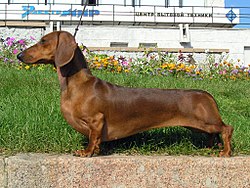
The dachshund is a short-legged, elongated dog breed of the hound family. Variations of the pronunciation include däks'hoont, -hʊnt, -hʊnd, -ənd, dɑks-, dæks-, dæʃ-), the breed's name is German and literally means "badger dog", from [der] Dachs, "badger", and [der] Hund, "dog". Due to the long, narrow build, they are sometimes referred to as a wiener dog or a sausage dog. Not withstanding the German origin of the dachshund's name, within German-speaking countries, the breed is known—both formally and informally—as the Dackel, or in the case of certified hunting and tracking rank, as Teckel.
While classified in the hound group or scent hound group in the United States and Great Britain, there may be some who consider the classification to be arguable, speculating that it arose from the fact that the word Hund, is similar to the English word hound, and the word "Dachshund" has even been both pronounced and translated, albeit incorrectly, as "Dash Hound".
Many dachshunds, especially the wire-haired sub type, may exhibit behavior and appearance that are similar to that of the terrier group of dogs. The standard size was developed to scent, chase, and flush badgers and other burrow-dwelling animals, while the miniature was developed to hunt smaller prey, like rabbits.
 An argument can be made for the scent or hound group classification because the breed was developed to utilize scent to trail and hunt animals, and probably descended from scent hounds, such as bloodhounds, pointers, Basset Hounds, or even Bruno Jura Hounds; with the dogged and persistent personality and love for digging that probably developed from the terrier, it can also be argued that they could belong in the terrier, or "earth dog", group.
In the Fédération Cynologique Internationale (World Canine Federation), or FCI, the dachshund is actually in its own group, Group 4, which is the dachshund group. Part of the controversy is due to the fact that the dachshund is the only certifiable breed of dog to hunt both above and below ground.
While classified in the hound group or scent hound group in the United States and Great Britain, there may be some who consider the classification to be arguable, speculating that it arose from the fact that the word Hund, is similar to the English word hound, and the word "Dachshund" has even been both pronounced and translated, albeit incorrectly, as "Dash Hound".
Many dachshunds, especially the wire-haired sub type, may exhibit behavior and appearance that are similar to that of the terrier group of dogs. The standard size was developed to scent, chase, and flush badgers and other burrow-dwelling animals, while the miniature was developed to hunt smaller prey, like rabbits.
 An argument can be made for the scent or hound group classification because the breed was developed to utilize scent to trail and hunt animals, and probably descended from scent hounds, such as bloodhounds, pointers, Basset Hounds, or even Bruno Jura Hounds; with the dogged and persistent personality and love for digging that probably developed from the terrier, it can also be argued that they could belong in the terrier, or "earth dog", group.
In the Fédération Cynologique Internationale (World Canine Federation), or FCI, the dachshund is actually in its own group, Group 4, which is the dachshund group. Part of the controversy is due to the fact that the dachshund is the only certifiable breed of dog to hunt both above and below ground.


